
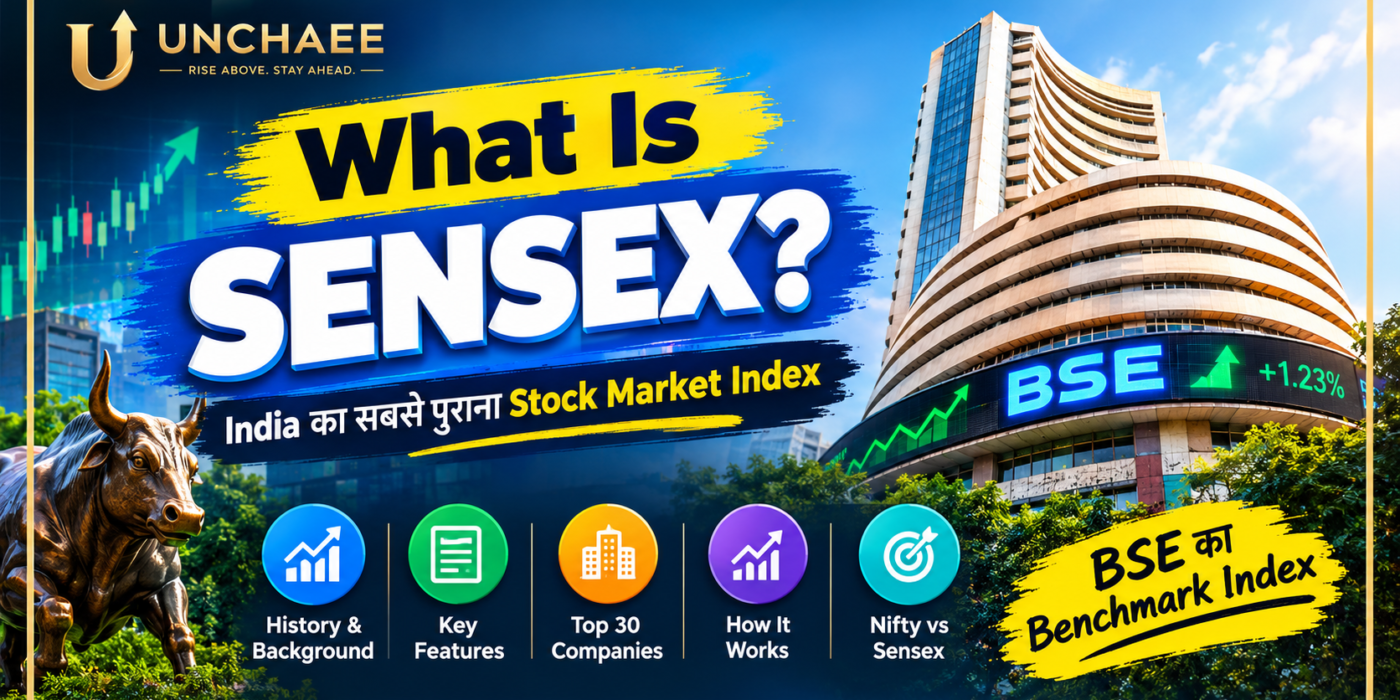
What Is SENSEX? A Beginner’s Guide to India’s Stock Market Index
If you have recently started learning about the Indian stock market, you have probably heard the word SENSEX many times. You may see headlines such as “SENSEX rises” or “SENSEX falls” and wonder what exactly it means.
In simple terms, SENSEX is a stock market index that tracks the performance of 30 large, established and financially sound companies listed on BSE. It is one of the most widely followed indicators of the Indian equity market. BSE says the SENSEX was launched on January 2, 1986.
For a beginner, understanding SENSEX is useful because it provides a quick way to understand how a selected group of major Indian companies is performing. However, SENSEX itself is not the entire Indian stock market.
What Is SENSEX?
The word SENSEX comes from Sensitive Index. It is the flagship index of the Bombay Stock Exchange, commonly known as BSE.
Today, the BSE SENSEX is designed to measure the performance of 30 large, liquid and financially sound companies across important sectors of the Indian economy.
Think of SENSEX like a report card for a selected group of major companies. Instead of looking at the price movement of hundreds of individual stocks separately, an investor can look at the SENSEX to get a quick picture of how these important companies are performing collectively.
It is important to remember that SENSEX does not represent every company listed on BSE. It represents a specific group selected according to index rules.
How Does SENSEX Work?
The value of SENSEX changes during market hours as the prices of its constituent stocks change.
But every company in the index does not necessarily have the same influence on the index. SENSEX uses a free-float market-capitalisation methodology. BSE explains that a float-adjusted index considers the shares available for trading rather than simply using the total number of shares issued by a company.
This means that companies with larger free-float market capitalisation generally have a greater influence on the movement of the index.
For example, if several heavily weighted companies experience significant price changes, their movements can have a noticeable effect on the SENSEX.
How Is SENSEX Calculated?
A beginner does not need to memorise the complete mathematical formula to understand SENSEX.
At a basic level, the calculation considers:
- Stock prices
- Number of outstanding shares
- Shares available in the free float
- The index divisor used in the calculation
BSE’s index methodology describes the float-adjusted calculation using stock price, total shares outstanding, an Investable Weight Factor and the index divisor.
The important point is that SENSEX is not simply the average price of 30 stocks.
The index methodology is designed to reflect changes in the market value of its constituents while maintaining continuity in the index.
Why Does SENSEX Go Up or Down?
One of the most common questions beginners ask is: “Why does SENSEX rise or fall?”
The answer is that many factors can influence the prices of the companies included in the index.
Some common factors include:
1. Company Performance
Changes in company earnings, revenue, business growth and future expectations can influence stock prices.
2. Economic Conditions
Interest rates, inflation, economic growth and other macroeconomic conditions can affect investor expectations.
3. Global Markets
Indian markets can also react to major developments in global financial markets, international interest rates, commodity prices and geopolitical events.
4. Investor Sentiment
Sometimes market prices move because investors collectively become more optimistic or cautious about future conditions.
Therefore, a rising SENSEX does not automatically mean that every stock in India is rising. Similarly, a falling SENSEX does not mean that every listed company is falling.
Why Is SENSEX Important for Beginners?
For someone new to the stock market, SENSEX can be a useful starting point for understanding market movements.
Suppose you see that SENSEX increased during a trading session. This tells you that, overall, the market value of its selected constituents increased according to the index methodology.
SENSEX is also used as a benchmark for evaluating market performance. BSE describes it as a benchmark and investable index representing 30 large and well-established companies across key sectors.
However, beginners should avoid treating one day’s SENSEX movement as a complete picture of the Indian economy or stock market.
SENSEX vs NIFTY: What Is the Difference?
SENSEX and NIFTY are both major Indian stock market indices, but they belong to different stock exchanges.
SENSEX is associated with BSE and tracks 30 selected companies.
NIFTY 50 is associated with the National Stock Exchange and tracks 50 selected companies.
Both are widely followed market benchmarks, but their constituent companies, methodology and index structure are different.
For beginners, the easiest way to remember the difference is:
SENSEX = BSE’s flagship 30-stock index
NIFTY 50 = NSE’s flagship 50-stock index
This simple distinction can help you understand financial news more easily.
Does a Rising SENSEX Mean the Market Is Always Good?
Not necessarily.
SENSEX represents a particular group of companies. The performance of smaller companies, sectors or individual stocks may be different from the movement of SENSEX.
For example, SENSEX may rise while some individual stocks decline. Similarly, SENSEX may fall while some stocks or sectors perform positively.
This is why beginners should understand what an index actually measures instead of using its movement as the only measure of market conditions.
Can Beginners Invest Directly in SENSEX?
SENSEX itself is an index, not an individual company share.
There are financial products designed to track market indices, but understanding how such products work, including their risks and costs, is important before making any financial decision.
If you are a beginner, first focus on learning concepts such as stock market basics, market capitalisation, index methodology, risk, diversification and long-term investing principles.
This article is intended only for general education and information. It is not a recommendation to buy, sell or hold any security.
Important Things Beginners Should Remember
When learning about SENSEX, keep these points in mind:
- SENSEX tracks 30 selected companies listed on BSE.
- It is a market index, not an individual stock.
- Its calculation uses free-float market capitalisation methodology.
- Its value changes as constituent stock prices change.
- SENSEX does not represent every company in India.
- A rise or fall in SENSEX does not mean every stock is moving in the same direction.
- Past market performance should not be treated as a guarantee of future results.
Frequently Asked Questions About SENSEX
What does SENSEX stand for?
SENSEX is commonly expanded as Sensitive Index. It is the flagship index associated with BSE.
How many companies are included in SENSEX?
The BSE SENSEX is designed around 30 companies representing major sectors of the Indian economy.
Is SENSEX the same as BSE?
No. BSE is the stock exchange, while SENSEX is an index associated with BSE.
Can SENSEX fall even when some stocks rise?
Yes. SENSEX represents a selected group of companies, and its movement depends on the combined movement and weighting of its constituents.
Is SENSEX useful for stock market beginners?
Yes, understanding SENSEX can help beginners learn how market indices work and how major companies can influence an index. However, it should be treated as one market indicator rather than a complete picture of every listed company.
Conclusion
Understanding What Is SENSEX is one of the basic steps for anyone starting to learn about the Indian stock market.
In simple words, SENSEX is a BSE index that tracks 30 selected large and established companies. Its movement is influenced by the prices and free-float market capitalisation of its constituents.
For beginners, the most important thing is not to focus only on whether SENSEX is going up or down. Instead, learn what an index represents, how it is calculated and why its value changes.
Once you understand these basics, financial news and stock market terminology become much easier to follow.
Educational Disclaimer: This article is published for general educational and informational purposes only. It is not investment advice, a recommendation to buy or sell any security, or a promise of returns. Readers should conduct their own research and, where appropriate, consult a SEBI-registered investment professional before making investment decisions.