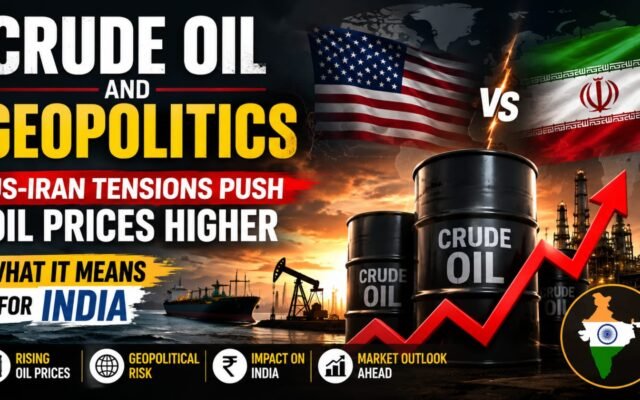

Crude Oil Surge & Middle East Tensions: What It Means for Global Markets and India
September 10, 2026
Crude oil prices have moved sharply higher as escalating tensions in the Middle East raise fresh concerns about global energy supplies. Brent crude has moved above the $100-per-barrel mark, while West Texas Intermediate (WTI) has also climbed significantly.
The latest move comes as military tensions involving the United States and Iran intensify and shipping activity around the strategically important Strait of Hormuz remains under pressure. The situation has increased uncertainty across global financial markets, with investors closely watching oil prices, inflation, bond yields, currencies and equity markets.
According to Reuters, Brent crude was trading around $102.15 per barrel, while WTI was around $97.50 on September 10. Brent has risen nearly 30% from its early-August lows.
Why Is Crude Oil Rising?
The biggest concern for the oil market is not simply the conflict itself, but the potential impact on physical oil supplies and transportation routes.
The Strait of Hormuz is one of the world’s most important energy chokepoints. A significant share of global crude oil and LNG shipments normally passes through this narrow waterway. Recent attacks on vessels and declining shipping traffic have increased concerns that oil exports could face further disruption.
Preliminary vessel-tracking data reported by Reuters showed that only seven vessels transited the Strait of Hormuz on Wednesday, compared with a 10-day average of 14. No LNG tankers exited the strait that day.
For oil traders, this creates a classic supply-risk premium. Even before an actual shortage develops, markets can price in the possibility of future supply disruptions.
Middle East Conflict Is Tightening the Oil Market
The latest escalation has already affected production and exports.
A Reuters survey found that oil output from the 11 OPEC members fell by approximately 640,000 barrels per day in August, taking production to around 19.71 million barrels per day. Disruptions to Saudi exports and restrictions affecting Iranian shipments contributed to the decline.
This is important because the oil market was already sensitive to supply-demand balances. If production disruptions continue while transportation remains restricted, the market could become increasingly tight.
At the same time, there are signs that parts of the global energy system are adapting. Industry participants at the APPEC conference said marine-fuel availability at major shipping hubs has improved compared with the severe shortages seen earlier in the year. However, prices remain elevated and uncertainty around replacement supplies continues.
What Does $100+ Oil Mean for India?
India is particularly sensitive to crude oil prices because of its heavy dependence on imported energy.
When international crude prices rise sharply, India’s import bill can increase. If this happens alongside a weaker rupee, the impact can become even more significant because oil is purchased internationally in U.S. dollars.
The Indian rupee has already come under pressure. Reuters reported that the rupee weakened to around ₹95.44 per U.S. dollar on September 10, with higher oil prices contributing to the pressure.
A weaker rupee and expensive crude can potentially increase costs across the economy, particularly for transportation, aviation, logistics and industries that use petroleum-based inputs.
Impact on the Indian Stock Market
The impact of higher crude prices is not uniform across the stock market.
Potential beneficiaries:
Oil exploration and production companies can benefit from higher realizations if elevated crude prices translate into stronger earnings. Upstream companies such as ONGC and Oil India can therefore attract greater investor attention during periods of rising crude prices.
Potential pressure:
Airlines, tyre manufacturers, paints, chemicals and other businesses with significant energy or petroleum-linked input costs can face margin pressure if they cannot fully pass higher costs to customers.
Oil marketing companies can also face uncertainty because their profitability depends on crude procurement costs, fuel pricing and government policy.
Recent Indian market commentary has highlighted this divergence, with oil producers gaining while several crude-sensitive sectors remained under pressure.
Could Crude Oil Reach $120?
The possibility of crude moving significantly higher cannot be completely ignored if the Middle East conflict results in a prolonged and substantial disruption to global supplies.
However, a move toward $120 should not be treated as a certainty or a forecast. Oil prices can change rapidly depending on military developments, diplomatic negotiations, shipping conditions, OPEC+ production decisions, global demand and strategic stock releases.
The key variable for investors is therefore not simply whether Brent crosses $100, but how long prices remain elevated and whether the physical supply disruption becomes larger or begins to normalize.
What Should Investors Watch Next?
There are five major indicators investors should monitor:
- Strait of Hormuz shipping traffic – Any further decline could increase supply concerns.
- Brent crude prices – Sustained prices above $100 would increase inflation and margin concerns.
- USD/INR – A weaker rupee can amplify the impact of expensive imported crude.
- OPEC+ production – Any additional supply response could reduce pressure on prices.
- Middle East diplomatic developments – A ceasefire or de-escalation could rapidly reduce the geopolitical risk premium.
Final Takeaway
The current crude oil surge is more than a commodity-market story. It has the potential to influence inflation, currencies, interest rates, corporate earnings and equity-market sentiment across the world.
For India, the combination of higher crude prices and a weaker rupee is particularly important. At the same time, the effect on individual sectors will vary considerably. Upstream oil producers may benefit from stronger crude prices, while airlines, paints, tyres and other crude-sensitive businesses may face higher costs.
For investors, the most important approach is to avoid reacting to a single headline. The direction of crude oil over the coming weeks will depend on whether Middle East supply disruptions worsen, stabilize or begin to reverse.
Disclaimer: This article is for educational and informational purposes only. It is not investment advice, a recommendation to buy or sell any stock, commodity, currency or financial instrument. Market conditions can change rapidly, particularly during periods of geopolitical uncertainty. Investors should conduct their own research and consider their financial objectives and risk tolerance before making investment decisions.